Children’s books carry a distinct responsibility because they introduce young readers to stories, emotions, and early learning experiences. Publishers, EdTech companies, and creative studios rely on strong visual narratives to hold a child’s attention. This is where professional illustrators shape children’s book characters and translate an author’s ideas into engaging visuals that communicate clearly across age groups and reading abilities. This guide explores how illustrators strengthen storytelling, support learning objectives, and create consistency across a book’s visual system.
Why Character Development Matters in Children’s Publishing
Children respond first to characters before they notice plot or structure. A well-built character guides them through the story, teaches them something, and keeps them engaged from one page to the next. When publishers handle large catalog volumes or EdTech teams build curriculum-based content, consistency becomes critical. Characters must feel relatable, warm, and easy to identify across scenes, moods, and learning levels.
Strong character development also helps small and mid-sized publishers compete with bigger lists. A single memorable character can define a series, increase retention, and build long-term brand value. It also gives production teams a reliable reference point for marketing, merchandise planning, and digital extensions.
How Illustrators Turn Concepts into Children’s Book Characters
Illustrators study the story’s emotional rhythm before drawing a single line. They consider age appropriateness, classroom relevance, cultural accuracy, and the pacing of visual information. Their work blends creativity with technique, giving publishers complete clarity across the character lifespan.
1. Understanding Core Traits
Illustrators break down the character’s purpose in the story. They define personality markers, expressions, body language patterns, and how the character should appear across key scenes. For EdTech platforms, this includes learning alignment. For example, if a character teaches math concepts, the expressions must be simple and steady to reduce cognitive load.
2. Building Early Sketches
Sketches explore shapes, proportions, and posture. Creative agencies and book production studios use these sketches to test how well the character fits with the narrative flow. Most teams choose between geometric forms that feel friendly to younger readers and more detailed forms for middle-grade content. This step removes ambiguity later in layout and formatting.
3. Finalizing the Character Sheet
Character sheets act as production blueprints. They document every angle, height, facial cue, clothing detail, and color palette. This documentation reduces hiccups during animation, interactive learning modules, and print layout. Publishers who maintain multiple series rely on these sheets heavily because they form part of the children’s book publisher’s checklist and remove guesswork from downstream stages.
4. Matching the Visual Style to the Story
Good illustrators tailor each element to the book’s tone. A soft watercolor style fits emotional journeys. A clean vector style works better for STEM content and EdTech frameworks. Production agencies choose styles based on scalability and conversion needs across print, digital, and learning systems.
Why Professional Illustrators Matter for Children’s Book Production
Characters children’s books succeed when the visuals support reading comprehension. Professional illustrators study how children absorb information and how visual hierarchy influences attention.
Clear Communication for Early Readers
Children depend on straightforward expressions and strong visual cues to follow meaning. Illustrated characters in children’s books must guide them through actions, emotions, and settings without overwhelming the page. The illustrator’s choices shape how well a child interprets scenes and connects with the story.
Cultural Accuracy and Inclusive Representation
Global publishers must serve different regions and languages. Creating character illustrations for children’s textbooks requires sensitivity and precision. Professional illustrators research clothing, environments, gestures, and skin tones carefully. This reduces compliance issues, classroom pushbacks, and rework during international localization.
Visual Continuity Across the Book
Continuity problems have a direct impact on production timelines. When layouts shift or spreads get rearranged, character development in children’s book illustration ensures the visuals still hold narrative integrity. A well-designed character stays recognizable even when placed in varied angles, backgrounds, or reading formats.
How Good Character Development Supports Book Layout and Formatting
Many publishers struggle with layout and formatting because the character structure is not defined early enough. Strong character planning reduces misalignment between visuals and text.
Better Text Flow
When the illustrator understands the character scale and placement, text wrapping becomes smoother. Production teams do not need to force content into awkward shapes or leave too much white space.
Consistent Reading Rhythm
Children’s books perform best when every page supports predictable reading movement. Balanced composition reinforces learning and comfort. A consistent character structure ensures this rhythm stays intact during multi-page spreads and chapter transitions.
Reduced Revision Cycles
Publishers lose time when characters shift unintentionally across pages. Strong character development ensures fewer redraws during corrections, which improves overall project efficiency and budget control.
How Characters Influence Learning in EdTech Content
EdTech platforms rely heavily on characters because they simplify instruction. Characters anchor lessons, reduce anxiety in young learners, and improve recall.
Personality as a Teaching Tool
Characters demonstrate actions instead of explaining them. This method supports visual learners and reduces text dependency in early literacy stages.
Increased Engagement
Children stay focused when a familiar character guides them. It also supports curriculum sequencing because characters assist with continuity across videos, worksheets, and digital modules.
Clear Emotional Cues
Emotions support comprehension. Clear expressions help learners interpret context faster and retain information better. Illustrators understand how to use expressions in a way that aligns with pedagogical goals.
The Role of Creative Agencies and Book Production Studios
Creative studios handle character consistency during the entire production cycle. They manage artwork review, color grading, layout alignment, and prepress checks. Their teams ensure character illustration stays cohesive across multiple formats, including print books, e-learning assets, animated explainers, and marketing creatives.
Integrated Art Pipelines
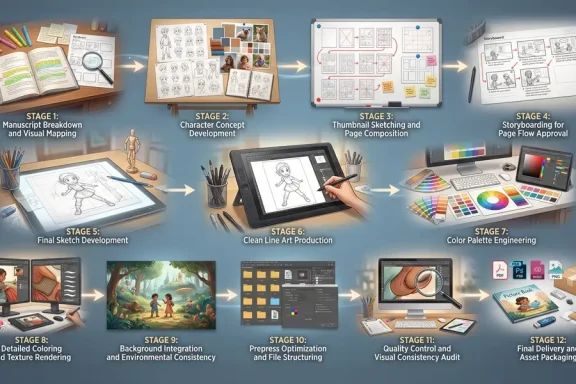
Studios use structured pipelines to coordinate character sheets, text alignment, and page design. These systems lower the risk for large catalogs and support tight deadlines for seasonal releases.
Iterative Review Systems
Professional review cycles allow publishers to refine poses, adjust visual rhythm, and ensure the character aligns with the larger learning or storytelling strategy.
How Digital Workflows Influence Character Development
Digital tools speed up testing and help teams evaluate composition early. Layered artwork, pose libraries, and scalable vectors help publishers adapt characters for future projects. Many publishers also build long term assets so the character can transition into videos, games, or classroom activities.
The Impact of AI in Children’s Publishing
AI in children’s publishing has changed the industry’s workflow, especially during early sketching and concept testing. Although AI helps with rapid idea generation, production studios still depend on skilled illustrators to refine shapes, fix anatomical accuracy, and maintain consistency across a full book. AI also assists in layout analysis, quality checks, and asset tagging. Human oversight remains essential for authenticity and child-safe visual expression.
Common Pain Points Publishers Face with Character Development
Publishers often face production delays and uneven visual quality when character planning is not structured from the start. A clear development framework helps teams avoid costly rework and maintain consistency across formats.
1. Inconsistent Character Styles
Publishers often receive illustrations from multiple freelancers, which creates an uneven visual tone. A full character development system avoids this.
2. Delays Due to Missing Specifications
When production teams skip early character sheets, formatting issues appear during layout. This leads to rework and cost overruns.
3. Misaligned Art and Learning Goals
EdTech teams need characters that teach, support, and reinforce learning intent. Without structure, illustrations compete with the content instead of supporting it.
4. Lack of Scalable Assets
Many publishers plan multi-title series but forget to create reusable character assets. Early planning solves this and speeds up future publishing cycles.
Why Professional Services Matter
Art and illustration services help publishers build full character ecosystems instead of isolated drawings. This includes visual research, character sheets, scene breakdowns, and layout coordination. Production teams gain clarity, and the final book moves smoothly through prepress, proofreading, and print approval. A well-developed character becomes a long term asset that improves brand identity and reader recognition.
What Characters Children’s Books Illustrators Deliver in a Complete Package
A complete illustration package gives publishers every asset needed to maintain visual accuracy throughout production. It streamlines collaboration between writers, layout teams, and prepress specialists, ensuring the character stays consistent across the book. A complete package includes:
- Character profile
- Turnaround sheet
- Expression sheet
- Pose library
- Color palette
- Scene exploration
- Style guide for layout coordination
This structure improves accuracy across digital transformations and ensures the character remains consistent during localization or repurposing for EdTech platforms.
The Long-Term Value of Strong Character Development
Strong characters create repeat readership. They give publishers a competitive edge and help EdTech platforms build educational continuity. Recognizable characters improve brand identity and make the content more memorable. When illustrators understand the business context, they create visuals that support long-term catalog expansion, marketing use cases, and cross-platform adaptation.
Final Thoughts
Character development shapes the identity of children’s books. Skilled illustrators give stories personality, clarity, and emotional connection. When publishers and EdTech teams collaborate with professional artists, they gain a structured visual system that strengthens storytelling and supports production quality. The right character strategy reduces workflow risk, enhances reading engagement, and ensures the book meets every standard on the children’s book publisher’s checklist.
FAQs
How do illustrators create effective children's book characters?
Illustrators study traits, build sketches, refine expressions, document turnarounds, and coordinate with layout teams to ensure characters stay consistent across scenes, learning modules, and production formats.
Why do publishers need character sheets?
Character sheets reduce errors, control style drift, support layout consistency, streamline revisions, and help production teams maintain accurate visuals during prepress, formatting, and localization workflows.
How do characters support EdTech learning outcomes?
Characters simplify abstract ideas, guide young learners, increase engagement, strengthen emotional cues, and provide continuity across digital lessons, worksheets, explainer videos, and interactive learning sequences.
How do art and illustration services create value for publishers?
They deliver structured visual systems, strengthen storytelling, align characters with learning goals, reduce revision cycles, and support efficient production across print, digital, and multilingual publishing requirements.